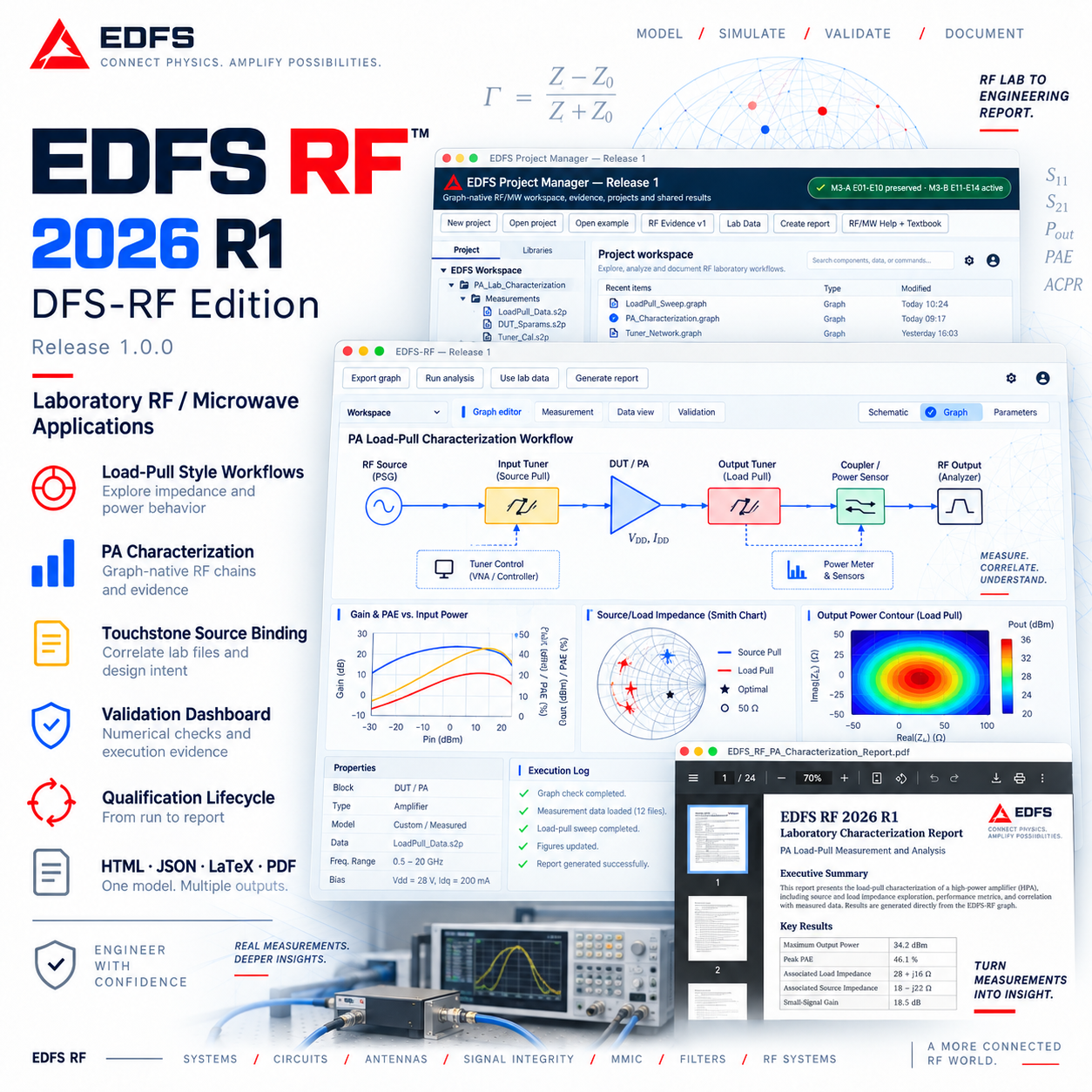

EDFS RF 2026 R1 Released — Graph-Native RF/Microwave Engineering with DFS-RF
Maxdi Research | Cognitave Inc. | September 2026Maxdi Research and Cognitave Inc. announce the release of EDFS RF 2026 R1, the RF/microwave engineering edition of the EDFS graph-native engineering environment.
EDFS RF extends the EDFS Core architecture with DFS-RF capabilities for RF/microwave engineering, bringing project structure, engineering graphs, computational models, parameter management, validation, numerical execution, results, and technical reporting into a coordinated design-flow environment.
The release represents an important transition in the EDFS program: from development of the underlying graph-native engineering architecture toward a product that RF and microwave engineers can begin evaluating through executable examples, technical demonstrations, and practical engineering workflows.
From RF Simulation to an Engineering Design Flow
RF and microwave engineering increasingly depends on multiple computational environments.
A practical workflow may involve network calculations, circuit models, electromagnetic simulation, imported S-parameter data, measurements, reduced models, numerical scripts, system analysis, and technical reporting.
The difficulty is often not performing an individual calculation.
The larger problem is maintaining the relationships among those calculations as a design changes.
EDFS approaches this problem by treating engineering information as part of a graph-native design flow.
Instead of viewing a project only as a collection of independent files and simulation runs, EDFS can organize:
engineering objects,
models and parameters,
computational kernels,
transformations,
dependencies,
validation state,
results,
reports,
and provenance
inside a connected project architecture.
For RF/microwave applications, DFS-RF provides the specialized engineering layer operating within that architecture.
EDFS RF Demo 1
E0–E19 Reference Examples: Load, Validate, Run, Report and Compile PDF
The first public demonstration introduces the basic EDFS RF workflow through the built-in E0 through E19 engineering examples.
The workflow follows a straightforward execution sequence:
Load Example → Validate → Run → Generate Report → Compile PDF
The examples give users a direct entry point into the released software without requiring them to first construct a complete project.
The demonstration also shows an important architectural distinction within EDFS:
Validation and execution are separate engineering operations.
Validation determines whether the required graph structure, engineering objects, connections, data, and execution contracts are ready.
Run then performs the corresponding numerical computation.
The resulting project state can subsequently be transferred into an engineering report and compiled into a PDF technical record.
Watch Demo 1
EDFS RF 2026 R1 Demo 1 — E0–E19 Reference Examples
https://youtu.be/c0oba1IV82w?is=uNM8jWGj2zynmHSG
EDFS RF Demo 2
Inside the DFS-RF Graph-Native Engineering Workspace
The second demonstration moves beneath the reference-example interface and into the deeper DFS-RF engineering workspace.
The workspace organizes the engineering process around the sequence:
Project → Engineering Graph → Models & Parameters → Validation → Execution → Results → Engineering Record
The project hierarchy provides access to the engineering objects and computational resources associated with the active RF design.
At the center is the graph-native workspace, where models, data, transformations, computational kernels, and analysis stages can be represented as connected engineering objects.
This architecture is intended to preserve an important piece of engineering information that is frequently lost between independent tools:
the dependency and ancestry of a result.
A numerical result should remain connected to the model, inputs, transformations, execution path, and validation conditions from which it originated.
That becomes particularly important when the design changes.
Rather than assuming that an entire computational workflow must always be repeated, graph-native engineering creates a foundation for asking a more precise question:
What changed, what remains valid, and what actually needs to be recomputed?
This principle becomes increasingly important as RF workflows combine circuit analysis, numerical electromagnetics, measurements, reduced-order models, system simulation, radar processing, and other computational domains.
Watch Demo 2
EDFS RF 2026 R1 Demo 2 — Inside the DFS-RF Engineering Workspace
https://youtu.be/oN19TfL54G8?is=UriuIMYdM5S5Kp8r
EDFS RF 2026 R1 — DFS-RF Edition
The released EDFS RF DFS-RF Edition is intended for RF and microwave engineers working with graph-native computational design flows and related engineering analysis.
The RF edition builds on the underlying EDFS architecture while introducing capabilities and workflows directed toward RF/microwave engineering.
EDFS RF — Professional Single-User License
Graph-Native RF/Microwave Engineering — Release 1.0.0, DFS-RF Edition
EDFS Core 2026 R1
EDFS RF is built on the broader EDFS Core concept: a graph-native engineering design-flow environment intended to organize engineering objects, computational execution, validation, results, and provenance in a common architecture.
EDFS Core provides the foundational environment for users whose requirements are not limited to the specialized RF/microwave DFS-RF edition.
EDFS Core — 2026 R1
Graph-Native Engineering Design Flow Software
https://www.cognitave.com/ee-store/p/edfs-2026-r1-graph-native-engineering-design-flow-software
CRE-RF and DFS-RF
The EDFS RF release is also connected to the ongoing development of CRE-RF — Cognitave RF Engineering.
CRE-RF develops the theoretical and computational language behind a deformation-aware treatment of RF engineering, including concepts such as:
typed RF representations,
deformation and sensitivity,
engineering boundaries and events,
robustness and recoverability,
stochastic RF behavior,
reduced-model fidelity,
array and radar propagation,
model authority,
graph-native execution,
and mixed-domain / mixed-depth engineering relationships.
DFS-RF translates this broader methodology toward executable RF engineering workflows inside EDFS.
The objective is not to replace established electromagnetic, circuit, network, or RF simulation methods.
Instead, the objective is to provide an architecture in which those methods can participate in a traceable, computationally connected engineering design flow.
Why Graph-Native RF Engineering?
Modern engineering projects routinely outgrow the assumptions of a single simulation environment.
An RF engineer may move between:
geometry → EM model → ports → network representation → circuit → measured data → reduced model → system response → engineering decision
Each transition can introduce differences in reference planes, normalization, coordinate systems, model fidelity, numerical assumptions, authority, and provenance.
In a conventional workflow, much of this information is maintained manually by the engineer.
Graph-native engineering attempts to make these relationships explicit.
This creates a foundation for design flows that can become:
more reproducible, more traceable, more selectively executable, and more computationally economical as complexity increases.
What Comes Next
The first two demonstrations establish the entry point.
Additional EDFS RF demonstrations are planned around:
individual E0–E19 engineering examples,
DFS-RF numerical execution,
RF graph construction,
model and parameter management,
CRE-RF computational examples,
model fidelity,
selective recomputation,
validation workflows,
LaTeX and PDF reporting,
imported electromagnetic and measurement data,
RF/system co-simulation,
XiRA workflows,
radar engineering,
and mixed-domain engineering applications.
The objective is to expose progressively more of the EDFS engineering workflow through practical demonstrations rather than presenting the platform only through documentation.
Explore EDFS
EDFS RF 2026 R1 — DFS-RF Edition
https://www.cognitave.com/ee-store/p/graph-native-rfmicrowave-engineering-release-100-dfs-rf-edition-professional-single-user-license
EDFS Core 2026 R1
https://www.cognitave.com/ee-store/p/edfs-2026-r1-graph-native-engineering-design-flow-software
Demo 1 — E0–E19 Reference Examples
https://youtu.be/c0oba1IV82w?is=uNM8jWGj2zynmHSG
Demo 2 — DFS-RF Engineering Workspace
https://youtu.be/oN19TfL54G8?is=UriuIMYdM5S5Kp8r
Maxdi Research
https://www.maxdi.com/research
EDFS / Maxdi
https://www.maxdi.com/system
EDFS 2026 R1
Electronics Design Flow Studio
From engineering objects to executable design flows.
© 2026 Maxdi Inc. / Cognitave Inc.