

From Crisis to Cohesion —National Resilience, Institutional Strength, and the Lessons of COVID-19
The COVID-19 pandemic tested more than medicine. It exposed how scientific uncertainty, executive authority, legislative oversight, legal constraints, media narratives, financial markets, enterprise operations, and public behavior interact under stress.
A conventional history can list the events: the first alerts, emergency declarations, shutdowns, mask guidance, fiscal relief, vaccine trials, reopening, variants, mandates, court decisions, and retrospective investigations. An institutional debrief must ask a harder question:
> How did decisions, incentives, information, and market reactions propagate across domains—and what can professionals learn from the resulting system behavior?
The MGSSSG COVID-19 Executive White Paper, publication MGSSSG-COVID19-WP-2026-001, introduces the Institutional Stability Engine (ISE): a mixed-domain, mixed-depth reference architecture for integrating fragmented evidence into a coherent institutional assessment.
Download the complimentary Executive White Paper (PDF)
Download Volume I — $49 (Purchase & Download on EE_Store
The Institutional Stability Engine
The Institutional Stability Engine (ISE) is the public-facing reference architecture of the MGSSSG methodology. It is grounded in the broader MXD-COGN framework developed by Maxdi Inc.
ISE organizes analysis into three linked stages:
1. Evidence inputs — scientific findings, executive actions, legislation, oversight, court decisions, economic indicators, market behavior, media narratives, enterprise performance, and international developments.
2. Mixed-domain, mixed-depth integration — analysis across institutional sectors and across levels ranging from global systems to national policy, cities, commercial districts, and individual enterprises.
3. Decision outputs — assessments of institutional stability, enterprise resilience, strategic risk, policy effects, market outlook, and opportunity windows.
The objective is not to force every event into one political narrative. It is to make the analytical path explicit: what was observed, who acted, under what authority, with which assumptions, through which feedback channels, and with what consequences.
A chronology of actors, decisions, and acceleration
The institutional story begins before the first shutdown.
In late 2019 and early 2020, clinical signals emerged in Wuhan and entered the international information system. The World Health Organization, national public-health agencies, laboratories, and governments began interpreting incomplete evidence while travel, trade, and financial markets continued to operate.
In the United States, President Donald Trump, the White House Coronavirus Task Force, HHS, CDC, FDA, NIH, state governors, and local officials operated through overlapping authority structures. Anthony Fauci, Deborah Birx, Robert Redfield, Francis Collins, Jerome Adams, and many state and municipal health leaders became visible institutional actors. Their guidance reached a public that rarely saw the full evidentiary chain behind each recommendation.
The mask debate illustrates the resulting coherence problem. Early public messages reflected uncertainty, supply scarcity, and evolving understanding of asymptomatic transmission. CDC shifted in April 2020 to recommend cloth face coverings. The scientific position could evolve; the institutional challenge was explaining why it evolved, which assumptions changed, and how scarcity management differed from evidence about effectiveness.
At the same time, presidents, governors, mayors, courts, businesses, parents, and workers contested the legal and economic boundaries of shutdowns, school closures, occupancy limits, travel rules, and later vaccine requirements. Andrew Cuomo and Gavin Newsom used extensive emergency restrictions during early waves. Ron DeSantis moved earlier toward reopening and later opposed many mandates. The Biden administration pursued federal vaccination requirements; the Supreme Court later blocked OSHA’s broad large-employer rule while allowing the health-care rule to proceed.
ISE treats these measures as multi-domain control actions. A mandate affects health risk, legal authority, enterprise cost, household burden, public trust, and political legitimacy simultaneously.
Emergency as an innovation accelerator
The vaccine sprint demonstrated what becomes possible when scientific platforms, public funding, regulation, manufacturing, and logistics are reorganized around an emergency objective.
The achievement did not begin in 2020. Katalin Karikó and Drew Weissman helped solve foundational problems in modified mRNA. Jason McLellan and collaborators advanced prefusion-stabilized coronavirus spike design. Barney Graham, Kizzmekia Corbett, and teams at the NIH Vaccine Research Center helped translate platform knowledge into a rapid SARS-CoV-2 response. Uğur Şahin and Özlem Türeci at BioNTech, together with Pfizer, and teams at Moderna converted platform capability into deployable vaccine programs.
Operation Warp Speed and related public programs altered the development topology. Government purchasing commitments reduced commercial risk. Manufacturing expanded before final trial results. Clinical phases, production planning, regulatory review, and distribution preparation proceeded with greater overlap than in ordinary development.
This was not simply a case of “bending the rules.” It was a case of parallelizing work, reallocating risk, using emergency legal authorities, and increasing review intensity under a declared evidentiary standard. FDA Emergency Use Authorization remained different from full approval, but it provided a pathway for use when known and potential benefits were judged to outweigh known and potential risks during the emergency.
The institutional lesson is broader than vaccines: crisis innovation is fastest when adaptable scientific platforms, technical interfaces, financing mechanisms, manufacturing capacity, and regulatory pathways already exist before the emergency.
Markets recovered before streets
The financial and physical economies did not recover on the same clock.
Federal Reserve Chair Jerome Powell and the Federal Reserve cut rates, supported credit markets, and created emergency facilities. Congress and the executive branch enacted the CARES Act and subsequent relief measures. These interventions helped prevent a financial collapse and supported household and enterprise liquidity.
Yet a rising equity market did not reopen a restaurant, refill a hotel, restore commuter traffic, or remove rent obligations from a closed storefront. Technology firms, cloud providers, delivery platforms, and remote-work tools captured demand rapidly. Physical enterprises depended on occupancy, tourism, labor availability, predictable rules, and geographic foot traffic.
The divergence matters because market indexes are incomplete measures of institutional recovery. ISE requires analysts to track the street economy, household balance sheets, operating capacity, real estate, labor, and geographic demand alongside financial assets.
Accountability as a model update
A serious debrief does not end when the emergency declaration ends.
Congressional oversight, court decisions, released records, peer-reviewed research, and economic data continue to update the pandemic record. In 2024, former NIAID Director Anthony Fauci participated in a two-day transcribed interview and later testified publicly before the House Select Subcommittee on the Coronavirus Pandemic. Committee majority staff said he responded that he did not recall relevant matters more than 100 times and highlighted his statement that the six-foot distancing rule had “sort of just appeared.”
The distinction is important: the public committee record describes failures of recollection and disputed policy explanations. It does not support characterizing those responses as more than 100 invocations of the Fifth Amendment.
That precision is central to the ISE method. Retrospective evidence should strengthen accountability without allowing allegation, inference, and established fact to collapse into one category.
The institutional issue is larger than one witness. A public system that cannot reconstruct who decided, on what evidence, under which authority, with what review, and with which revision triggers will struggle to distinguish justified adaptation from avoidable error.
Five lessons for future disruptions
The Executive White Paper develops five practical lessons:
● Authority without coherence loses legitimacy. Changing guidance can reflect learning, but the evidence trail and revision logic must be visible.
● Emergency can compress innovation time. Acceleration depends on prior scientific capacity, shared interfaces, public finance, manufacturing readiness, and regulatory architecture.
● Mandates are multi-domain control actions. A policy that optimizes one domain while ignoring law, enterprise, equity, and trust can weaken system-wide stability.
● Markets can recover before streets do. Financial stabilization must be evaluated separately from physical commerce and operating capacity.
● Accountability must update the model. Hearings, records, litigation, and new research are evidence streams that refine the institutional assessment.
Download the Executive White Paper
Institutional Debriefing: COVID-19 — Executive White Paper
Publication: MGSSSG-COVID19-WP-2026-001
Publisher: Cognitave Inc., a Maxdi company
Series: MGSSSG Institutional Debriefing Series
Download the complimentary PDF
The White Paper is designed for executives, policy and legal professionals, investors, public-health and technology leaders, researchers, and enterprises building continuity or crisis-intelligence systems.
Why another COVID-19 publication?
COVID-19 has already generated an enormous archive. The problem is not the absence of information. It is fragmentation.
Public-health records explain disease control. Scientific papers explain research and clinical findings. Court opinions define legal boundaries. Market data describe financial repricing. Enterprise records reveal operational survival. Congressional testimony and released documents add retrospective evidence. Media archives show how public narratives formed and changed.
Each record is valuable, but none is sufficient alone.
MGSSSG approaches the pandemic as a coupled institutional system. The central unit of analysis is not an isolated decision. It is the trajectory produced when decisions, constraints, incentives, communications, and reactions move across institutional layers.
The White Paper therefore uses COVID-19 as a demonstration case for a broader analytical method—one designed for professionals who need to understand what moves politics, markets, media, enterprises, and long-horizon stability.
Continue with the complete Volume I
The complimentary White Paper is the public gateway. The premium MGSSSG COVID-19 Institutional Debriefing, Volume I provides the full chronology, doctrine, legal and economic analysis, enterprise case studies, commercial-survivability framework, institutional lexicon, methodology, and reference architecture.
Explore the complete report in the Cognitave EE Store
About MGSSSG
The Maxdi Global Strategic Stability Studies Group (MGSSSG) develops mixed-domain, mixed-depth institutional debriefings for complex events affecting politics, markets, media, technology, law, enterprise, and long-horizon stability.
Its purpose is to transform fragmented history into traceable institutional intelligence—and institutional intelligence into strategic capability.
Citation: Haghzadeh, Mahdi. Institutional Debriefing: COVID-19—Executive White Paper. MGSSSG-COVID19-WP-2026-001. Cognitave Inc., 2026.
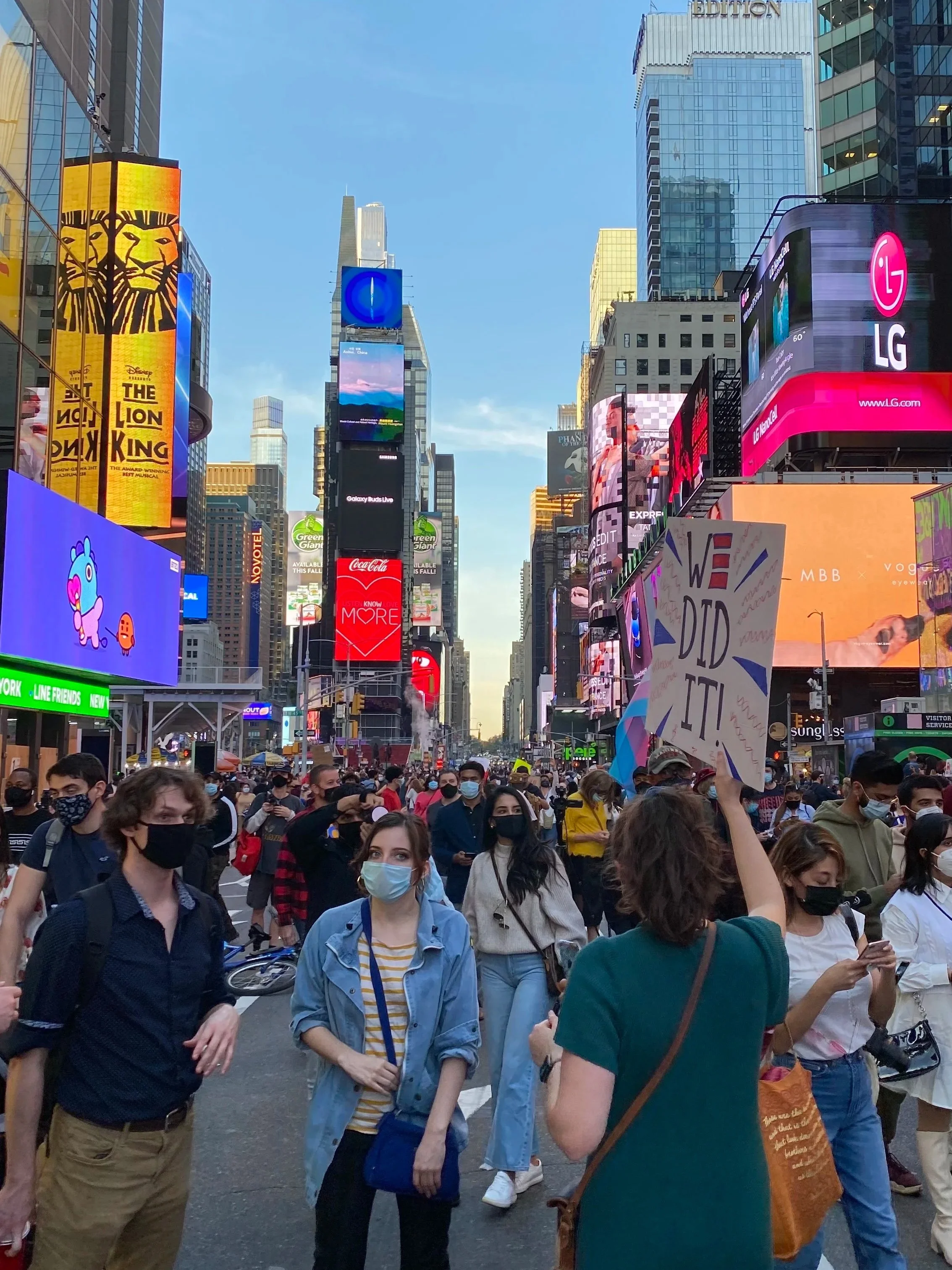
Nov 7, 2020 at 3:56 PM taken by an Apple Iphone 11 Pro Max Wide camera -- 26 mm f1.8 | 9 MP . 2268x4032 . 2.4 MB Times Square, NY.
